A patient’s decision to consult a doctor can begin well before they call the hospital or walk through its doors.
They may search for a specialist, compare doctors, visit a hospital website, read patient reviews, watch a video or explore social media. Each interaction contributes to how they perceive a doctor’s expertise and the hospital’s credibility.
For doctors and hospital leadership teams, this makes digital presence more than a visibility exercise. Digital marketing for doctors should help patients find reliable information, understand a doctor’s expertise and take the next step with confidence.
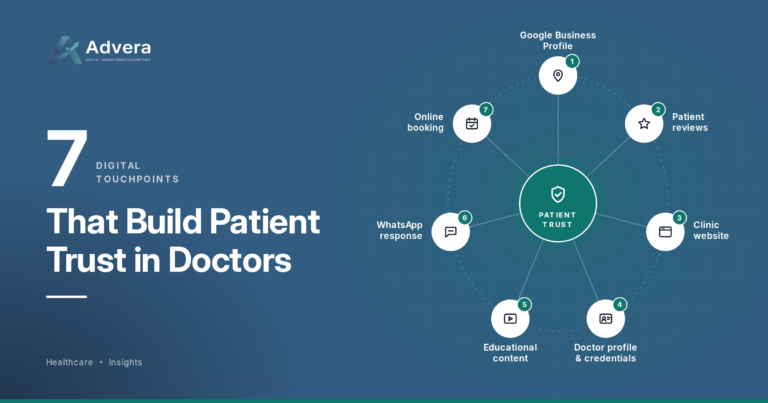
Here are seven points in the digital journey where that trust can be influenced.
1. Google Search
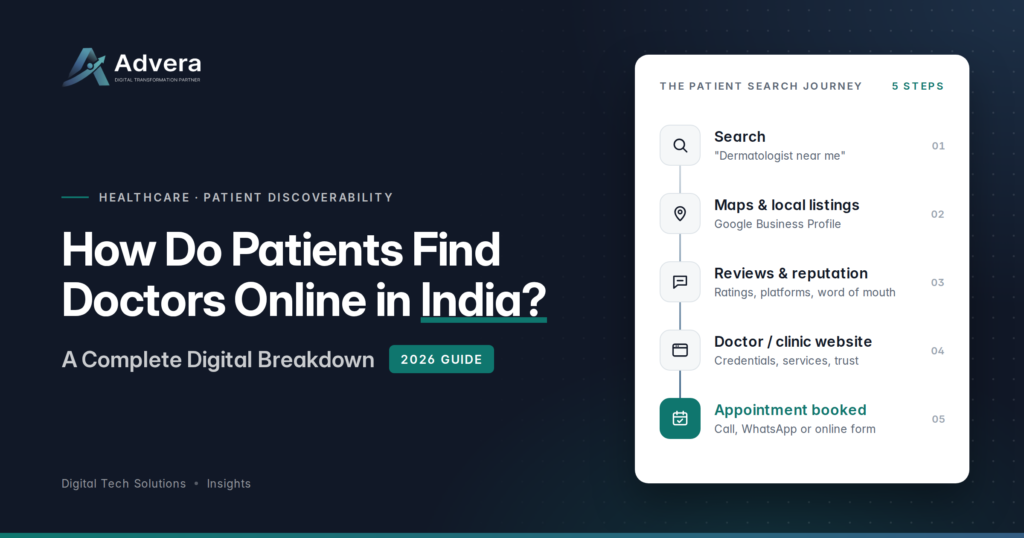
The patient journey often starts with a search.
A person may search for a doctor’s name, a speciality or a healthcare service in a particular location. The results can introduce them to several doctors and hospitals before they visit any website.
This is where search visibility becomes important. However, appearing in search results is only the beginning. The information patients encounter should accurately represent the doctor’s speciality, professional background and hospital affiliation.
For hospital teams, digital marketing for doctors should focus on making relevant and useful healthcare information discoverable rather than focusing on rankings alone.
2. The Doctor’s Profile on the Hospital Website
A doctor’s profile can be one of the most important pages on a hospital website.
Before booking, patients may want to verify qualifications, experience, speciality, areas of expertise, consultation location and appointment details.
An incomplete or outdated profile can leave important questions unanswered. A clear and current profile gives patients a better basis for deciding whether the doctor is appropriate for their needs.
Hospital teams should therefore treat doctor profiles as key digital assets, not simply staff directory entries. They are an important part of digital marketing for doctors because they connect a patient’s initial interest with credible professional information.
3. The Hospital Website and Appointment Journey
Patients evaluate more than an individual doctor. They are also forming an impression of the hospital.
After discovering a doctor, they may explore speciality pages, treatments, facilities, locations and other doctors in the department. If the website is difficult to navigate or the appointment process is unclear, interest can be lost.
For hospital management, website performance should therefore be considered alongside patient acquisition.
A well-structured healthcare website should help a visitor move from discovering a doctor to understanding the relevant service and finding the appropriate appointment or enquiry channel without unnecessary friction.
4. Local Search and Google Business Profile
Healthcare decisions are often closely connected to location.
A patient searching for a cardiologist in Kochi, for example, may consider where the doctor consults, how accessible the hospital is and whether the required service is available.
Accurate location, contact information, operating hours, photographs, reviews and website links can all contribute to that evaluation.
For hospitals with multiple branches, keeping information accurate for each location becomes even more important. Local search should be managed as an ongoing part of the digital strategy. In digital marketing for doctors, local visibility can be particularly valuable when patients are already looking for a specialist they can access.
5. Patient Reviews and Online Reputation
A hospital can explain its services, but prospective patients can also look at what other patients have experienced.
Reviews may influence perceptions of communication, waiting times, hospital environment and the overall patient experience. The way a hospital responds to feedback can also shape its public image.
The answer is not to pursue perfect ratings at any cost. Genuine feedback, appropriate responses and attention to recurring concerns provide a more sustainable approach to reputation management.
For hospital leadership, online reputation should be monitored continuously. Reputation management is therefore an important part of digital marketing for doctors, particularly when prospective patients are comparing several specialists or hospitals.
6. Social Media and Doctor-Led Content
Social media gives patients another way to understand the people behind a hospital’s services.
Doctor-led educational videos, health awareness content, department updates, hospital initiatives and answers to common health questions can make clinical expertise more accessible.
The most effective healthcare content does not need to turn every post into a promotion. It can demonstrate what a doctor knows and what a hospital offers in a way that patients can understand.
For doctors, this can strengthen professional visibility. For hospitals, it can communicate the expertise available across departments.
Healthcare communication also requires responsibility. Content should avoid exaggerated promises, misleading claims and sensational messaging. This balance between visibility and credibility is central to effective digital marketing for doctors.
7. Expert Content Before the Patient Chooses a Doctor
Not every patient starts by searching for a doctor’s name.
Many start with a question.
Someone experiencing persistent hair loss may first search for possible causes. A person with recurring joint pain may research the condition before deciding which specialist to consult. This is where expert-led content becomes valuable.
Speciality pages, articles, videos and patient education resources can answer genuine questions while introducing the expertise available at the hospital. When this content is accurate, appropriately attributed and created to help people rather than simply target keywords, it can support both patient education and discoverability.
Google’s guidance recommends helpful, reliable, people-first content and places greater emphasis on strong E-E-A-T for topics that can significantly affect people’s health and wellbeing. This makes expert content an important component of digital marketing for doctors, provided the information is created and reviewed responsibly.
How Advera Helps Hospitals Build a Stronger Digital Presence?
Managing these touchpoints requires more than maintaining a website or posting regularly on social media. Search visibility, website experience, doctor profiles, content, reputation and digital campaigns need to support the same patient journey.
Advera helps hospitals build and manage this connected digital presence through website development, search marketing, social media, content and other digital marketing services.
The approach is centred on helping healthcare organisations communicate their expertise clearly, reach relevant audiences and create a smoother path from online discovery to patient enquiry.
For doctors and hospital leadership teams, this means digital activity can be approached as a connected strategy rather than a collection of separate marketing tasks.
Bringing the Seven Touchpoints Together
These touchpoints do not operate independently.
A patient might discover a doctor through Google, visit the hospital website, read the doctor’s profile, check the hospital’s local presence, look at reviews and then watch a doctor-led video before deciding whether to enquire.
That is why digital marketing for doctors should not be reduced to SEO, social media or advertising in isolation. Search visibility, website experience, doctor profiles, reputation, local presence and expert content all have a role in the wider patient journey.
For hospital leaders, the more useful question is not simply, “Are we visible online?”
It is:
When a prospective patient searches for our doctors, does everything they find provide accurate information, demonstrate expertise and make the next step clear?
A strong digital presence should answer that question consistently. When the right information is available across the right touchpoints, digital marketing becomes more than promotion. It becomes part of how a hospital earns attention, demonstrates credibility and builds patient confidence before the first consultation.